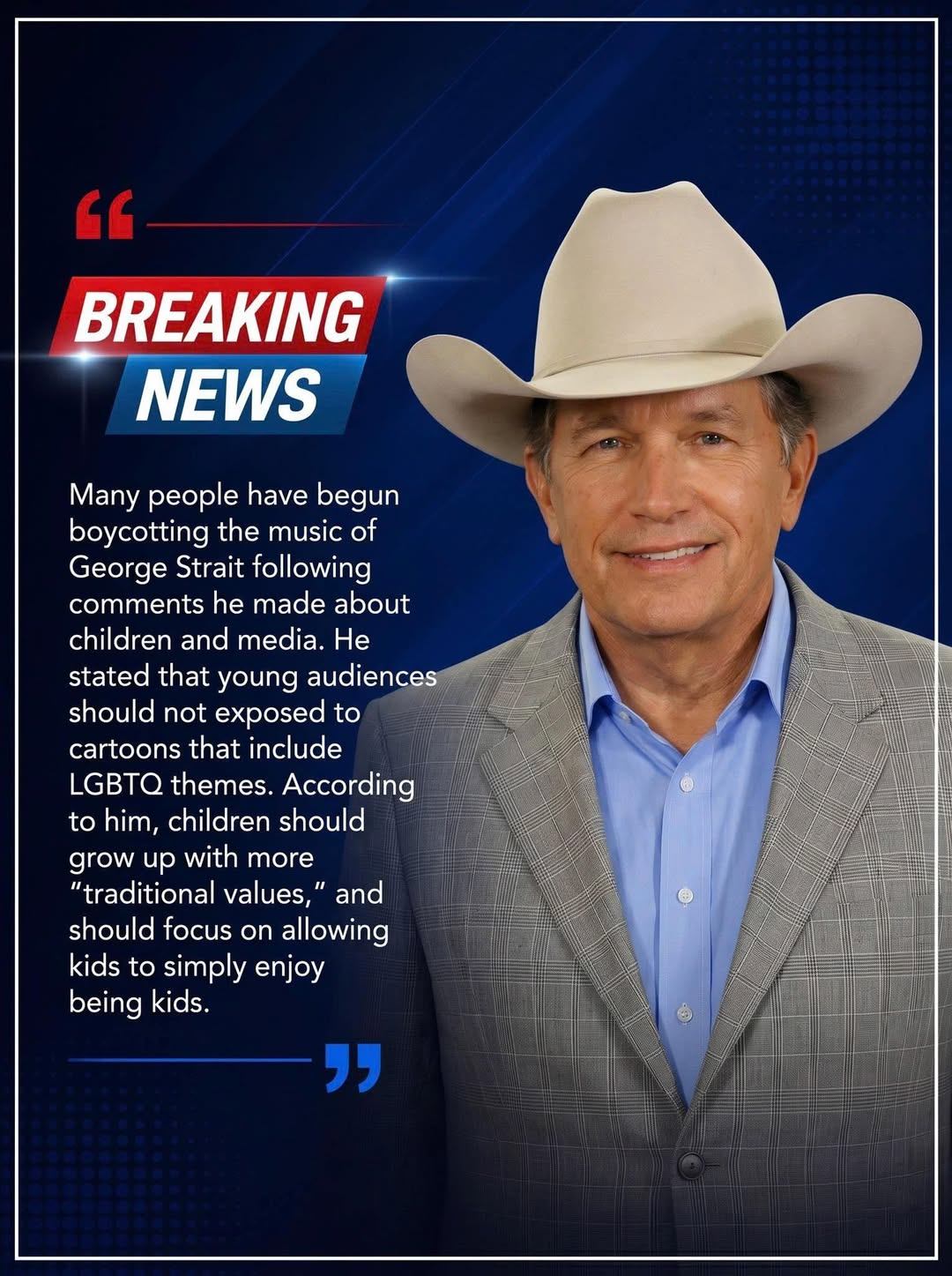
GEORGE STRAIT’S REPORTED COMMENTS JUST IGNITED A FIRESTORM — AND COUNTRY FANS ARE NOW SPLIT DOWN THE MIDDLE
In an era where a single statement can ripple across the world in seconds, even the most respected voices are not immune to controversy.
This week, George Strait—a figure long associated with quiet dignity, humility, and tradition—found himself at the center of an unexpected and rapidly escalating debate.
It began with circulating reports.
Unverified by direct official statements, yet widely shared across social media, the reports claimed that Strait had spoken about the “spiritual stewardship of the next generation” and expressed concern regarding LGBTQ-related themes in modern cartoons and children’s media.
Within hours, the reaction was immediate.
And deeply divided.

A Reputation Built on Stability
For decades, George Strait has occupied a rare space in American culture.
He is not known for controversy.
He does not chase headlines.
He rarely inserts himself into cultural or political debates.
Instead, his career has been defined by consistency—musically, personally, and publicly.
That is precisely why the reaction to these reported comments has been so intense.
Because for many, this moment feels unexpected.
Almost out of character.
What Was Actually Said?
At the center of the debate lies a crucial question:
What exactly did George Strait say?
According to the circulating narrative, Strait suggested that children should be raised with stronger “Biblical, traditional foundations.”
For some, this statement reflects a familiar perspective—one rooted in personal belief, family values, and faith.
For others, the concern lies in how such statements may be interpreted in the context of broader conversations about inclusion, representation, and acceptance.
And without a fully verified, complete transcript or context, the ambiguity has only intensified the discussion.
Fans React: Disappointment and Defense
As clips and quotes spread, fan reactions began to form two clear camps.
On one side, some longtime supporters expressed disappointment.
They argued that the reported remarks feel at odds with the image of George Strait they have admired for years—an artist who embodies respect, grace, and quiet unity.
To them, the concern is not just about the content of the statement.
It is about the potential impact.
Particularly on younger audiences who may already feel vulnerable or marginalized.
On the other side, many fans rushed to Strait’s defense.
They cautioned against drawing conclusions from incomplete or unverified reports.
They emphasized that speaking about family values or faith does not automatically equate to exclusion or judgment.
And they pointed out that Strait has built a decades-long reputation for avoiding divisive rhetoric.
The Role of Context
One of the most important elements in this situation is context.
In today’s digital landscape, statements are often reduced to fragments.
A single sentence.
A short clip.
A headline.
But meaning is rarely contained in isolation.
Without the full context—tone, setting, intention—it becomes difficult to fully understand what was meant.
And yet, reactions are often formed instantly.
Shared widely.
And reinforced through repetition.
A Broader Cultural Conversation
What began as a reported comment from a country music icon has quickly expanded into something much larger.
A conversation about the role of public figures in cultural debates.
A discussion about the balance between personal belief and public influence.
A reflection on how society navigates differences in values.
Because at its core, this moment is not just about George Strait.
It is about the expectations placed on those in the public eye.

Influence and Responsibility
Critics of the reported remarks have raised an important point:
Influence matters.
When someone with George Strait’s reach speaks—whether directly or through reported comments—the impact extends far beyond a single audience.
Particularly when it comes to topics involving identity, representation, and youth, words can carry significant weight.
They can shape perceptions.
They can influence conversations.
They can affect how individuals feel seen—or unseen.
The Defense: Freedom of Belief
Supporters, however, emphasize a different principle.
The right to personal belief.
They argue that artists, like anyone else, are entitled to their perspectives—especially when those perspectives are rooted in personal values or faith.
From this viewpoint, discussing “traditional foundations” is not inherently divisive.
It is a reflection of a worldview shared by many.
And silencing or criticizing that perspective, they argue, risks limiting open dialogue.
The Digital Amplification Effect
One of the defining characteristics of this moment is how quickly it escalated.
Within minutes, hashtags began trending.
Clips were shared.
Opinions multiplied.
And what may have started as a single reported comment became a nationwide conversation.
This is the reality of the digital age.
Information—verified or not—moves fast.
Reactions move faster.
And nuance often struggles to keep up.
The Question at the Center
As the debate continues, it has gradually narrowed to a single, central question:
Was George Strait simply expressing his views on family values?
Or did those views, as reported, cross a line for some members of his audience?
It is a question without a simple answer.
Because it depends on perspective.
On interpretation.
On personal experience.
The Complexity of Public Identity
For an artist like George Strait, whose career has largely avoided controversy, this moment represents a shift.
Not necessarily in who he is.
But in how he is being perceived.
Public identity is complex.
It is shaped not only by what someone says, but by how those words are received.
And once a narrative takes hold, it can be difficult to reshape.
What Happens Next?
As of now, the situation remains fluid.
There has been no widely confirmed, detailed clarification directly addressing the reported comments.
And until there is, speculation will likely continue.
Debates will persist.
Opinions will evolve.
But one thing is certain:
This moment has sparked a conversation that goes far beyond a single statement.

Conclusion: A Reflection of the Times
In many ways, this controversy reflects the broader cultural landscape.
A time when values, identity, and expression intersect in complex and often challenging ways.
A time when public figures are expected not only to entertain—but to navigate deeply personal and societal issues.
And a time when audiences are more engaged, more vocal, and more divided than ever before.
For George Strait, a man whose legacy has been built on quiet strength and steady presence, this moment represents something new.
A test—not of his music, but of how his voice is understood in a rapidly changing world.
And as fans, critics, and observers continue to weigh in, one truth remains:
Sometimes, the most powerful conversations are not about what was said—
But about what people believe it meant. 🎶